ONE TEAM. ONE FIGHT.
Signed in as:
filler@godaddy.com
ONE TEAM. ONE FIGHT.
Signed in as:
filler@godaddy.com
Storage requirements are defined by the application - not simply by capacity, form factor, or interface.
Consider a high-rate ISR data recorder continuously ingesting sensor data, a mission computer boot drive dominated by reads, and an embedded compute platform constrained by power and thermal limits. All require reliable storage, but the optimal SSD architecture for each can be very different.
Performance. Power. Capacity. Write Endurance. Security. Operating Environment. SWaP. Lifecycle.
These requirements interact and often compete. Maximum performance can increase power and thermal load. Higher NAND density can trade against write endurance. Additional capacity can improve endurance but consume valuable space and power. Security requirements can influence system architecture and data-management strategy.
MEMKOR works directly with your engineering team to understand these trade-offs and configure the storage architecture around your platform, workload profile, operating environment, and program life.
DESIGN FOR THE DATA
Storage architecture starts with understanding how your application actually moves data.
Sequential or random. Read-intensive or write-intensive. Continuous or burst. Small transfers or large blocks. Each workload places different demands on the SSD controller, NAND, interface, power, and thermal architecture.
High-rate ISR, EO/IR, radar, SIGINT, data recording, and Edge AI applications may require sustained throughput over long operating periods. Boot drives and mission computers may instead prioritize latency, power consumption, deterministic behavior, or long-term reliability.
UNDERSTAND THE WORKLOAD
Sustained Throughput | IOPS | Read/Write Ratio | Transfer Size | Duty Cycle | Queue Depth | Interface | Temperature
MEMKOR evaluates the complete workload to select the appropriate interface, NAND, controller, capacity, and storage architecture.
MAXIMUM INTERFACE SPEED DOES NOT ALWAYS MEAN MAXIMUM SYSTEM PERFORMANCE
PCIe provides tremendous bandwidth, but performance must be considered alongside power, thermal constraints, workload, and operating environment. For some applications, SATA remains the better system-level solution.
DESIGN FOR HOW MUCH DATA YOU WRITE
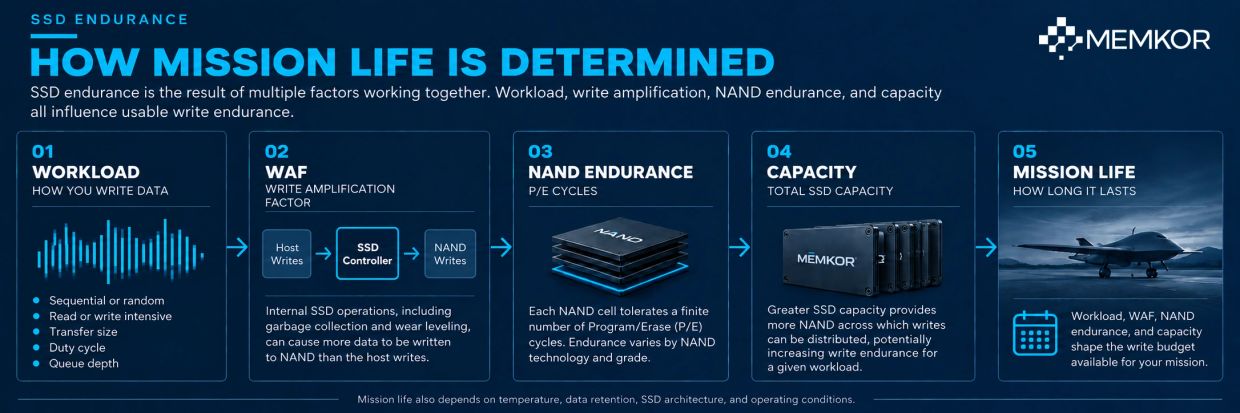
NAND flash has finite write endurance. Determining how long an SSD will last requires understanding much more than its advertised capacity or P/E cycle rating.
Workload, Write Amplification Factor (WAF), NAND endurance, SSD capacity, over-provisioning, temperature, and flash-management architecture all influence usable SSD life.
WORKLOAD -> WAF -> NAND ENDURANCE -> CAPACITY -> MISSION LIFE
MEMKOR offers multiple NAND technologies and endurance grades, including options up to 100K P/E cycles, allowing storage to be optimized around write workload and required service life.
Increasing SSD capacity can also increase endurance by providing additional NAND over which writes can be distributed. The smallest SSD that satisfies your capacity requirement is not necessarily the best SSD for your application.
Size storage for the mission, not just the dataset
DESIGN FOR WHERE IT OPERATES
Storage doesn't operate on a datasheet.
Temperature, shock, vibration, altitude, humidity, thermal constraints, connector reliability, and mechanical integration can significantly affect SSD performance and reliability.
MEMKOR storage can be configured for demanding operating environments using extended-temperature components, enhanced mechanical ruggedization, conformal coating, underfill, rugged connectors, conduction cooling, and application-specific mechanical designs.
ENGINEERED FOR EXTREME ENVIRONMENTS
Down to -55°C | Up to +105°C | Up to 30 gRMS Vibration | Up to 100G 11 ms Shock
Capabilities vary by product and configuration
IPC CLASS 3
PCBs can be manufactured to IPC-6012 Class 3 and assemblies built to IPC-A-610 Class 3 requirements for high-reliability applications.
RUGGED CONNECTIVITY
The SSD isn't the only component that must survive the environment. MEMKOR rugged SATA connector options provide significantly greater vibration capability and mating-cycle life than conventional SATA connections while maintaining a standard SATA footprint.
DESIGN FOR THE DATA YOU NEED TO PROTECT
Data-at-rest protection should be considered as part of the storage architecture, not added after the system has been designed.
MEMKOR self-encrypting SSDs provide hardware-based AES-256 encryption with TCG Opal 2.0 support, allowing authentication and access control to be implemented at the storage-device level.
Additional hardware and software capabilities provide options for protecting, locking, sanitizing, or preventing modification of mission-critical data.
DATA SECURITY CAPABILITIES
AES-256 | TCG Opal 2.0 | Self-Encrypting Drive (SED) | Write Protect | Crypto Erase | Secure Erase | PSID Revert | Military Erase such as NSA9-12 and NSA130-2.
DESIGN AROUND THE PLATFORM
Storage consumes more than capacity. It consumes board area, VPX slots, power, thermal budget, connectors, cabling, and system volume. Selecting the right storage architecture can free valuable system resources for processing, I/O, RF, AI acceleration, and other mission functions.
MEMKOR supports multiple architectures to integrate storage where it makes the most sense for the platform.
STANDARD SSDs
2.5", U.2, M.2, 1.8", mSATA and other industry-standard form factors for straightforward system integration.
XMC
Integrate high-capacity PCIe/NVMe storage directly onto a compatible SBC and preserve valuable VPX slots.
3U VPX
Conduction-cooled embedded storage with fixed, single-removable, or dual-removable configurations and PCIe/NVMe, SATA, or mixed interfaces.
FRED
Move storage outside the compute enclosure when internal space, slots, thermal constraints, or accessibility drive the architecture.
CUSTOM
Application-specific PCB, enclosure, connector, pinout, thermal, and mechanical configurations when standard architectures don't fit.
MAXIMIZE STORAGE DENSITY WITHIN AVAILABLE SWaP
Capacity requirements must be balanced against SWaP, write endurance, thermal performance, interface bandwidth, and environmental constraints.
MEMKOR combines high-density NAND, board-level integration, and configurable storage architectures to maximize capacity within available system volume.
HIGH CAPACITY STORAGE ARCHITECTURES
Standard Form Factor SSDs
U.2/2.5": Up to 16TB
M.2 2280: Up to 8TB
XMC
Up to 8TB
3U VPX
Up to 32TB
CAPACITY IS AN ARCHITECTURE DECISION
MEMKOR works with your team to balance usable capacity against SWaP, endurance, performance, environmental, and program requirements.
PERFORMANCE HAS A THERMAL COST
Higher interface speeds and sustained workloads increase controller activity, NAND activity, power consumption, and thermal load. In constrained embedded systems, peak benchmark performance may not represent sustained performance under actual operating conditions.
MEMKOR evaluates performance together with power, cooling, workload, and operating temperature to select the appropriate interface and storage architecture.
DON'T JUST COMPARE DATASHEETS
Evaluate storage under the workload, temperature, and operating conditions your platform will actually experience.
For some applications, maximum PCIe performance is the priority. For others, lower-power SATA, conduction-cooled storage, additional thermal margin, or a different mechanical architecture may provide the better system-level solution.
YOUR PLATFORM. YOUR CONFIGURATION
Standard storage doesn't always fit in Defense and Aerospace platforms.
Mechanical keep-out zones, connector locations, pinouts, heat sinks, standoffs, PCB dimensions, conduction paths, power requirements, host interfaces, and system packaging can all drive storage integration.
With control over hardware and firmware, MEMKOR can adapt storage around application-specific requirements without forcing the system architecture around a commercial SSD.
CONFIGURABLE BY DESIGN
Form Factor | PCB | Pinout | Connector | Interface | Capacity | NAND | Firmware | Security | Thermal | Mechanical
From a modified standard SSD to an integrated XMC, VPX module, FRED, or fully custom design, MEMKOR engineering works directly with your team through integration and qualification.
DESIGN IT ONCE. SUPPORT IT FOR YEARS.
Defense and Aerospace platforms frequently remain in production and sustainment far longer than commercial SSD product lifecycles.
Controller, NAND, DRAM, PCB, and firmware changes can trigger additional engineering evaluation and qualification—even when the commercial SSD model number remains unchanged.
MEMKOR offers Locked Bill of Material (L-BOM) and proactive obsolescence management to maintain configuration control, simplify qualification, and support long program lifecycles.
PROGRAM LIFECYCLE SUPPORT
Locked BOM | Configuration Control | PCN Management | Obsolescence Management | Long-Term Support
When a component reaches end-of-life, MEMKOR works with your team to transition to a form, fit, and function-compatible replacement while minimizing requalification effort and impact to the existing system design.
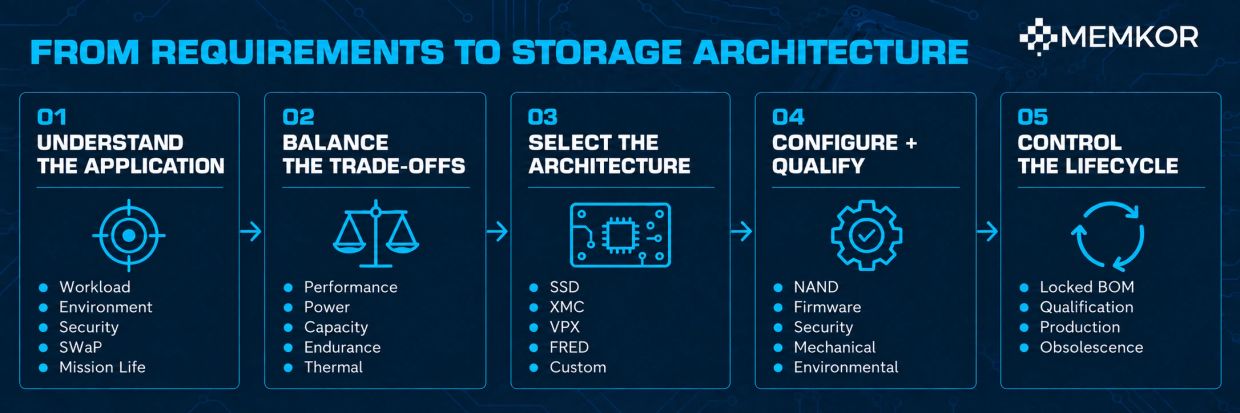
MEMKOR works directly with your engineering team throughout storage selection, integration, qualification, production, and sustainment.
Whether the requirement is a standard SSD, high-capacity XMC, removable VPX module, external FRED, or fully custom storage architecture, everything starts with your application.
Configuration control and proactive obsolescence management help simplify qualification and support long program lifecycles.
Our engineering team supports your program throughout integration, qualification, production, and the product lifecycle.

We use cookies to analyze website traffic and optimize your website experience. By accepting our use of cookies, your data will be aggregated with all other user data.