ONE TEAM. ONE FIGHT.
Signed in as:
filler@godaddy.com
ONE TEAM. ONE FIGHT.
Signed in as:
filler@godaddy.com
Edge AI platforms process data where it is generated - aboard aircraft, ground vehicles, surface ships, submarines, autonomous systems, and other deployed platforms where bandwidth, latency, connectivity, or security can limit reliance on centralized infrastructure.
These systems may simultaneously ingest sensor data, load AI models, perform inference, record mission data, maintain local datasets, and generate operational logs.
That creates a demanding and highly variable storage workload.
Sustained Performance. High Capacity. Write Endurance. Low Latency. Data Security. Power. Thermal. SWaP.
MEMKOR works with your engineering team to configure storage around the workload, compute architecture, operating environment, and program requirements.
THE ACCELERATOR PROCESSES IT. STORAGE KEEPS IT MOVING
AI compute performance depends on having the right data available when and where it is needed.
Storage within an Edge AI platform may be responsible for:
MODEL STORAGE + LOADING
Store trained models, weights, software, and supporting datasets required by the compute platform.
SENSOR INGEST
Capture high-rate video, EO/IR, radar, LiDAR, RF, telemetry, and other sensor streams.
LOCAL DATASETS
Maintain mission-specific datasets and other information required for local processing and inference.
MISSION RECORDING
Preserve raw sensor data, processed outputs, inference results, event data, and system logs.
SOFTWARE + MODEL UPDATES
Support field updates to models, applications, operating systems, and mission data.
DATA PROTECTION
Protect sensitive information stored aboard deployed systems.
EDGE AI ISN'T ONE STORAGE WORKLOAD
Edge AI can create simultaneous read- and write-intensive workloads. The storage subsystem may be loading models and datasets while continuously ingesting multiple sensor streams, recording raw data, and storing inference results.
READ WORKLOADS
Model loading | Dataset access | Mission-data retrieval | Software execution
WRITE WORKLOADS
Sensor ingest | Video recording | Telemetry | Inference results | Event logging
WORKLOAD VARIABLES
Sequential / Random | Read / Write Ratio | Transfer Size | Queue Depth | Duty Cycle | Sustained Data Rate
Peak interface speed alone does not define Edge AI storage performance.
PEAK SPEED IS ONLY PART OF THE STORY
Edge AI systems may need to sustain sensor capture and data recording for hours. Not seconds.
An SSD capable of high burst performance may behave very differently once caches are exhausted, NAND becomes heavily utilized, controller temperature rises, or the system reaches its operating-temperature extremes.
For continuous data acquisition, the critical requirement is often:
SUSTAINED WRITE PERFORMANCE
Can the SSD continuously accept data at the required rate throughout the operating environment?
MEMKOR evaluates sustained performance together with workload, NAND, interface, capacity, power, thermal design, and operating temperature.
DON'T JUST COMPARE DATASHEETS.
Evaluate storage under the workload, temperature, and operating conditions your platform will actually experience.
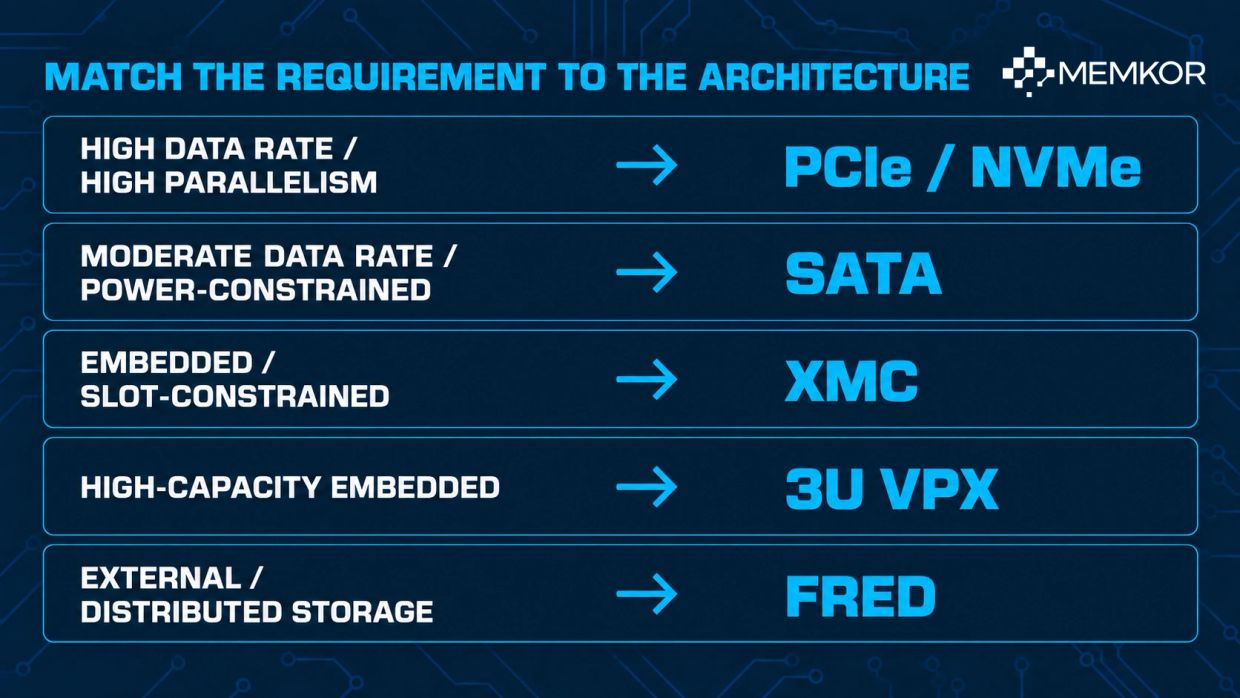
PCIe OR SATA? START WITH THE SYSTEM
PCIe/NVMe provides the bandwidth required for the most data-intensive Edge AI applications, but maximum interface performance comes with increased power and thermal considerations.
SATA may remain the better architecture for applications where required data rates are lower and power consumption, thermal margin, qualification maturity, or system simplicity carry greater weight.
THE FASTEST INTERFACE ISN'T ALWAYS THE BEST SYSTEM ARCHITECTURE.
DATA-INTENSIVE AI CAN BECOME WRITE-INTENSIVE STORAGE
Continuous video, radar, RF, telemetry, machine vision, and multi-sensor recording can generate significant write volumes over the life of a deployed platform.
SSD life depends on more than the amount of data retained at any one time.
WORKLOAD -> WAF -> NAND ENDURANCE -> CAPACITY -> MISSION LIFE
MEMKOR offers multiple NAND endurance options, including configurations up to 60K P/E cycles, allowing the storage subsystem to be sized around expected write volume and program requirements.
Higher SSD capacity can also increase available endurance by providing more NAND across which writes can be distributed.
Size storage for the write workload, not just the dataset
MORE SENSORS. MORE DATA. MORE STORAGE
Edge AI can reduce the amount of data that must be transmitted off-platform—but that does not necessarily reduce local storage requirements.
Platforms may need to retain raw sensor data, processed datasets, inference results, mission events, logs, models, and software simultaneously.
Capacity should therefore be evaluated against:
Sensor Data Rate | Number of Sensors | Retention Time | Redundancy | Write Endurance | Available SWaP
DATA RATE × RETENTION TIME = BASE STORAGE REQUIREMENT
Redundancy, over-provisioning, endurance margin, filesystem overhead, and mission-growth requirements should be considered when determining final storage capacity.
EVERY WATT MATTERS AT THE EDGE
Compute accelerators already consume significant platform power and thermal budget. Storage becomes part of that same system-level constraint.
Higher-performance controllers and interfaces can increase SSD power consumption and heat generation, particularly during sustained workloads.
MEMKOR evaluates:
Active Power | Idle Power | Sustained Workload | Cooling Architecture | Operating Temperature | Thermal Margin
Storage should be selected as part of the platform's power and thermal architecture, not independently from it.
AI DOESN'T ALWAYS LIVE IN A DATA CENTER
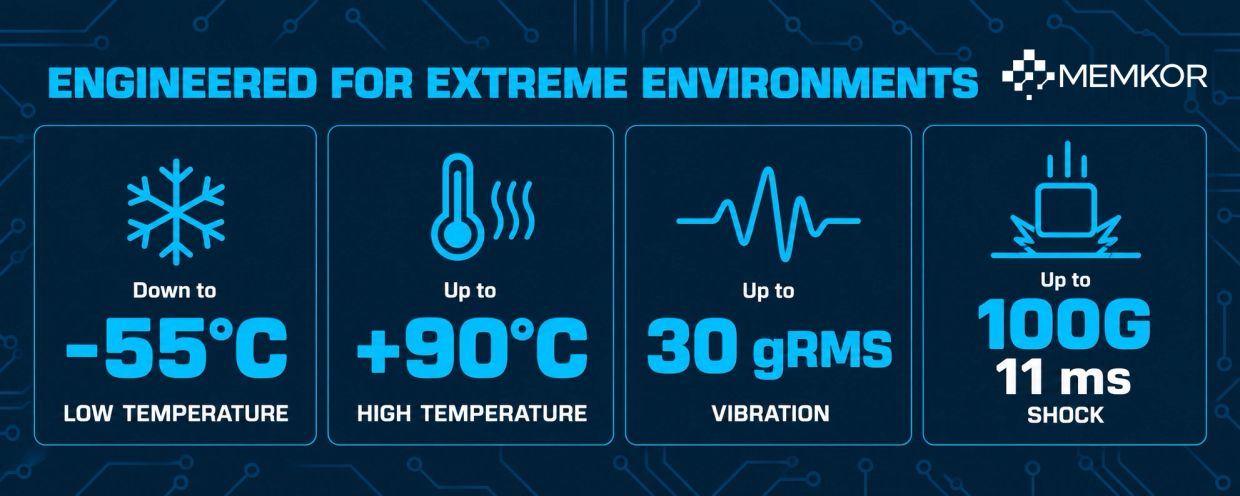
Deployed Edge AI systems may operate across extreme temperature, shock, vibration, altitude, humidity, and other environmental conditions far beyond a conventional data center.
MEMKOR storage can be configured with extended-temperature components, enhanced mechanical ruggedization, conformal coating, rugged connectors, conduction cooling, and other application-specific features.
Down to -55°C | Up to +90°C | Up to 30 gRMS Vibration | Up to 100G 11 ms Shock
*Capabilities vary by product and configuration
PROTECT THE DATA AT THE EDGE
Edge systems may contain trained models, sensor data, mission information, software, inference results, and other sensitive information outside physically controlled environments.
MEMKOR self-encrypting drives provide hardware-based AES-256 encryption and TCG Opal 2.0, with additional options for authentication, Write Protect, Secure Erase, Crypto Erase, and other data-protection capabilities.
AES-256 | TCG Opal 2.0 | Self-Encrypting Drive (SED) | Write Protect | Crypto Erase | Secure Erase | PSID Revert | Military Erase such as NSA9-12 and NSA130-2
DESIGN FOR THE UNEXPECTED SHUTDOWN
Vehicle power transitions, field servicing, faults, and unexpected shutdowns can interrupt storage operations without a controlled system shutdown.
Available hardware sudden-power-loss protection helps protect in-flight data and SSD metadata during unexpected power interruption.
ARCHITECTURE MATTERS
TANGERINE SERIES | PERFORMANCE WITHOUT COMPROMISE.
High-performance PCIe/NVMe and SATA storage for data-intensive workloads requiring maximum throughput and capacity.
BLACK SERIES | EXTREME RUGGEDIZATION. PROVEN RELIABILITY.
Extreme-environment storage for Edge AI systems operating across severe temperature, shock, and vibration.
XMC | MORE STORAGE. FEWER VPX SLOTS.
Integrate high-capacity NVMe storage directly onto compatible SBCs while preserving VPX slots for compute, AI accelerators, RF, and I/O.
3U VPX | HIGH-CAPACITY. CONFIGURABLE. VPX-READY.
Conduction-cooled embedded storage for high-capacity Edge AI architectures, with fixed and removable configurations.
FRED | ADD STORAGE. NOT A REDESIGN.
Move high-capacity storage outside the compute enclosure when internal space, thermal constraints, or system slots are limited.
ONE SIZE DOES NOT FIT ALL.
One Edge AI platform may require maximum PCIe throughput. Another may prioritize sustained write endurance. Another may be constrained by power, temperature, available VPX slots, or physical volume.
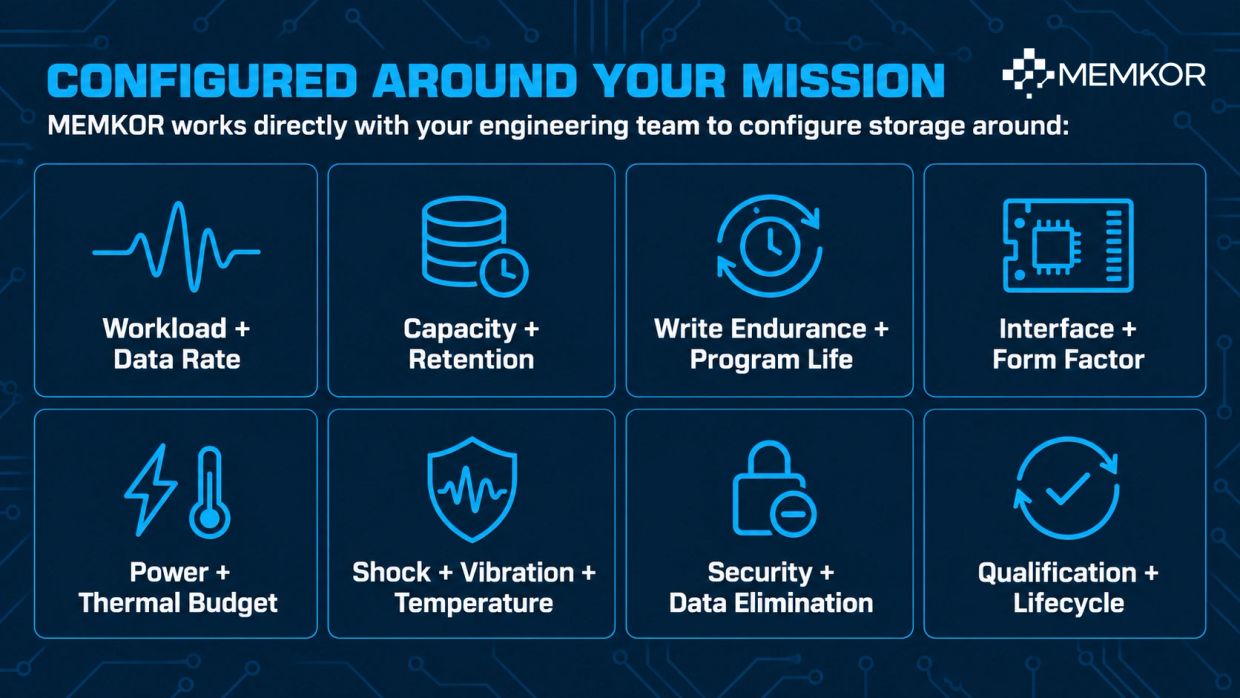
MEMKOR works directly with your engineering team to configure storage around:
Workload + Data Rate
Capacity + Retention
Write Endurance + Program Life
Interface + Form Factor
Power + Thermal Budget
Shock + Vibration + Temperature
Security + Data Elimination
Qualification + Lifecycle

3U VPX Storage
MEMKOR works with your team to optimize storage for your platform’s performance, power, capacity, security, and environmental requirements.
Configuration control and proactive obsolescence management help simplify qualification and support long program lifecycles.
Our engineering team supports your program throughout integration, qualification, production, and the product lifecycle.
We use cookies to analyze website traffic and optimize your website experience. By accepting our use of cookies, your data will be aggregated with all other user data.